
Immunoglycomics
This research group seeks to understand and treat disease. They develop chemical tools such as vaccines to treat infectious diseases.
Research focus
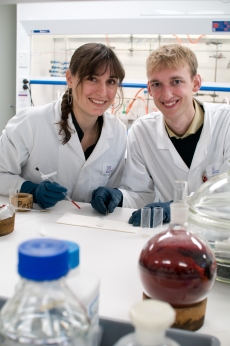
Nau mai, haere mai ki tō mātou whārangi ipurangi. Kei waenganui ō te mātai matū me te mātai koiora te take mātua ō tēnei rangahau. Mā te whakawhanake ō ngā taputapu pūtaiao, kā mārama. Mā te mārama, kia piki te ora …
Our core research lies at the interface of chemistry and biology and, in general, concerns the development of chemical tools to better understand and treat disease.
A key research theme involves vaccine development, particularly for infectious diseases that are over-represented in Māori and Pacific people (for example, Group A Streptococcus and Streptococcus pneumoniae), as well as therapeutics for diseases for which Māori and Pacific people have a worse prognostic outcome (for example, colorectal cancer).
To undertake this research, we develop new molecules, investigate how they interact with immune cells, and then team up with leading collaborators in the respective fields to bring our ideas to fruition.
In addition, we also have a small research team looking at methods to improve the efficiency of solar cells. That’s the beauty of organic chemistry—molecules are everywhere.
Below is a selection of research projects. This list is by no means exclusive but should give a flavour of our research programme.
Mauri oho
Mauri tū
Mauri ora ki a tātou
Haumi e, hui e, tāiki e!
Awaken the spirit
Engage the spirit
The spirit of life amongst us
Be united in purpose!
From: Tikanga Māori at Victoria
Featured research articles
Three research articles from PhD students in the Immunoglycomics group were selected to feature on covers of the Royal Society of Chemistry journal Organic and Biomolecular Chemistry in the space of three months. The journal’s editorial office noted that it was unusual to have so many profiles coming from the same source, but that the work justified it.
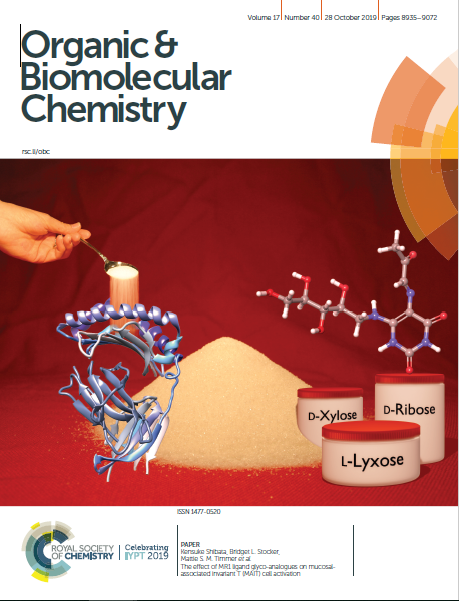
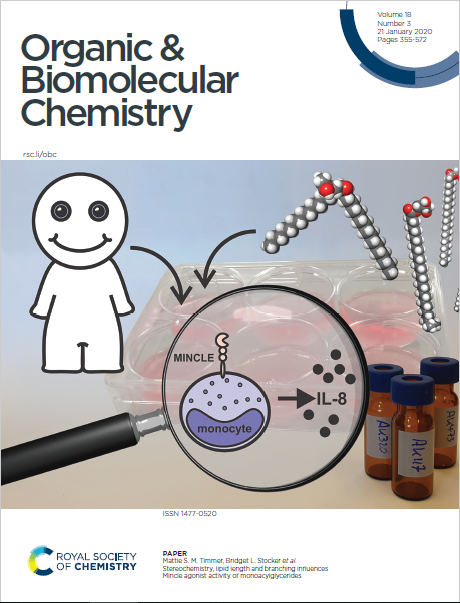
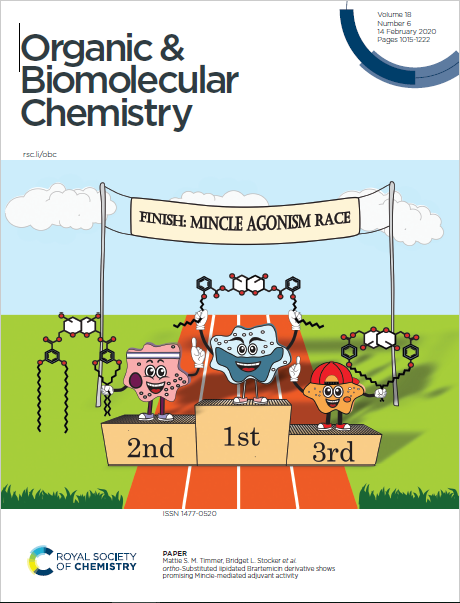
So special mention to:
Chriselle Braganza (PhD graduate)
‘The effect of MR1 ligand glyco-analogues on mucosal-associated invariant T (MAIT) cell activation.’ Chriselle D. Braganza, Kensuke Shibata,* Aisa Fujiwara, Chihiro Motozono, Koh-Hei Sonoda, Sho Yamasaki, Bridget L. Stocker, and Mattie S. M. Timmer. Org. Bio. Chem. 2019, 17, 8992–9000. https://doi.org/10.1039/C9OB01436E
Ayesha Khan (PhD graduate)
‘Stereochemistry, lipid length, and branching influences Mincle agonist activity of monoacylglycerides.’ Ayesha Khan, Chriselle D. Braganza, Kristel Kodar, Mattie S. M. Timmer and Bridget L. Stocker. Org. Bio. Chem. 2020, 18, 355-572. https://doi.org/10.1039/C9OB02302J
Dr Amy Foster
‘Ortho-substituted lipidated Brartemicin derivative shows promising Mincle-mediated adjuvant activity.’ Amy J. Foster, Kristel Kodar, Mattie S. M. Timmer and Bridget L. Stocker. Org. Bio. Chem. 2020, 18, 1015-1222. https://doi.org/10.1039/C9OB02397F
All work relates to the development of ligands for the immune cell receptor ‘Mincle’ or for a newly identified class of immune cell called a ‘MAIT’ cell. The application of this work is in the development of vaccine adjuvants or cancer immunotherapies. The work was supported through funding by the Health Research Council of New Zealand (Hercus Fellowship) and the Marsden Fund.
Current projects
The following research projects are now available:
- Vaccine adjuvant development for preventative vaccines
- Glycolipid adjuvants for anti-cancer immunotherapy
- MAIT cell ligands for therapeutic applications
- Carbohydrate ligation methodologies
- Improving solar cell efficiency
See Research projects for more information.
People
See a list of the current members of the Immunoglycomics research group.
Academic staff
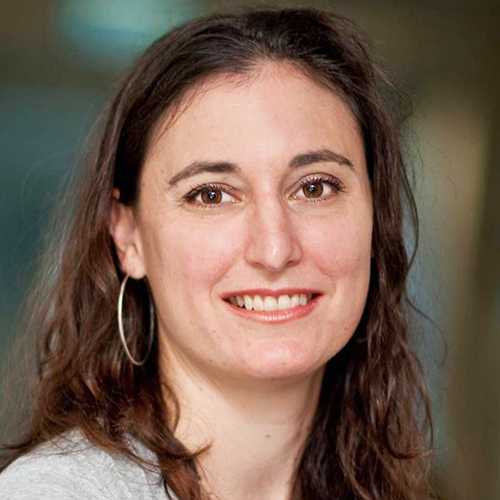
Associate Professor of Bio-Medical Chemistry
School of Chemical and Physical Sciences

Associate Professor
School of Chemical and Physical Sciences
Research highlights
"Te tiro atu to kanohi ki tairawhiti ana tera whiti te ra kite ataata ka hinga ki muri kia koe."
"Turn your face to the sun and the shadows fall behind you."

MBIE success—Better adjuvants for veterinary vaccines
Associate Professor Bridget Stocker talks about winning an MBIE research grant.
“Grants come and go—you win some, you lose some—but this is a particularly memorable one. In September 2018 a collaborator wrote to us expressing their congratulations on our recent Smart Ideas MBIE grant, which aims to develop better vaccines for sheep pathogens by selectively skewing the immune response. I was like, huh? You’re kidding, right?”
In 2018 Dr Stocker gave birth to twins. Along with a two-year-old toddler, she was now juggling the needs of three young children along with her work commitments. Keeping up with the MBIE research grant results was one of many things that fell off her radar.
“We wrote the MBIE grant when the twins were newborns, each sitting in bed at night holding a baby while doing our best to type with the other hand. Kudos to Justin and Natalie for visiting on one such occasion—our method of work would never have been believed otherwise.
“It was a mammoth effort to get the grant done, and at times I came close to slamming my computer shut so that I could just focus on what was already a challenging job of being a parent to three kids.
“Needless to say, I’m pleased we persevered. Now we have started an awesome collaboration with Neil, Axel, and Natalie from AgResearch and the initial results are very promising.”
Podcast—Dr Bridget Stocker and Dr Mattie Timmer
Vaccine adjuvants
Bridget reflects on her experience of being interviewed for national radio.
“I was due to have an interview with Kathryn Ryan on Radio New Zealand National in March 2018 on the development of vaccine adjuvants. However, this needed to be cancelled for a very good reason—I went into labour with my twins.
“We re-scheduled the interview, which we did six weeks later. Behind the scenes were an army of people looking after our twins and then two-year-old. Thanks! It was nice to get out of the house.”
To listen to the podcast, visit Radio NZ.
Publications
See a list of publications on immunoglycomics.
Vacancies
For information on current vacancies, contact Bridget Stocker or Mattie Timmer.
Research funding
Funding grants from the Marsden Fund, the Health Research Council of New Zealand, the Cancer Society, Lottery Health Research, the Wellington Medical Research Foundation, and from industry currently support our research programmes.