
Glacier and ice sheet modelling
Glacier and ice sheet modelling helps us to understand the ways glaciers and ice sheets respond to past, present and future climatic changes.
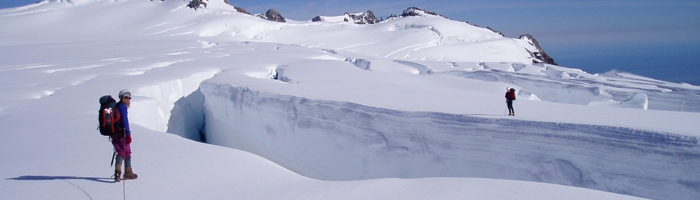
Our aim is to understand the role of glaciers and ice sheets in the Earth System. In particular, we investigate the interactions between ice and the climate system, both for projecting future changes, and for reconstructing past climates. Our team develops and applies computer models based on physical principles, and collects glaciological data from remote and challenging environments on alpine glaciers and polar ice sheets.
In New Zealand we are involved in a limited number of glacier monitoring programmes on Kā Roimata o Hine Hukatere/Franz Josef Glacier and Haupapa/Tasman Glacier.
We work on issues that are directly relevant to society, such as predicting the contribution from ice sheets and glaciers to sea-level rise as a consequence of global warming. We also work on improving understanding of more fundamental processes such as firnification, iceberg calving, sliding, and surface energy balance. Our group collaborates closely with ice-core scientists and geologists in the Antarctic Research Centre, as well as the Science Drilling Office. We also work with a number of international glaciology centres, New Zealand universities, and Crown Research Institutes.
Recent publications demonstrate the range and depth of our activities:
- How will the Antarctic Ice Sheet respond to climate warming? (URL)
- Why did some New Zealand glaciers advance during a period of global warming? (URL)
- How does surface debris cover influence glacier response to climate change? (URL)
- Why does snow accumulate on the up-wind side of Antarctic ‘megadunes’? (URL)
- How much colder was New Zealand during the Last Glacial Maximum? (URL)
- How can we reconstruct past climate from glaciers? (URL)
- What happens to glaciers when it rains? (URL)
People involved
Current funded research projects
- NIWA: Sub-contract Regional Climate Modelling core funding. Coupled Glacier-Hydrological Models - A. Mackintosh, B. Anderson (PIs).
- RSNZ Marsden Fund: Establishing Natural Baselines of Glacier Variability in a Warm World - S. Eaves (PI), A. Mackintosh (AI).
- RSNZ Marsden Fund: Did a Previous Collapse of the Antarctic Ice Sheet Cause Abrupt Climate Change in the Southern Hemisphere? - A. Mackintosh, B. Anderson (PIs), K. Norton, S. Eaves, L. Carter (AIs).
- RSNZ Rutherford Discovery Fellowship: Modelling the response of the Antarctic ice-sheet to a warming world and its contribution to future sea-level rise - N. Golledge (PI)).
- RSNZ Rutherford Discovery Fellowship: Accelerating Ice – The Role of Water in the Flow of Ice Sheets (H. Horgan (PI)).
- RSNZ Rutherford Postdoctoral Fellowship: Improving Understanding of Debris-covered Glacier Dynamics, Haupapa/Tasman Glacier, New Zealand - O. Wigmore (PI).
- GNS: Sub-contract Antarctic Ice Dynamics MBIE-Antarctic Science Platform funding. H. Horgan (PI).