
ANZICE
Antarctica-New Zealand Interglacial Climate Extremes sought to understand the likely response of the New Zealand-Antarctic region to a warmer world.
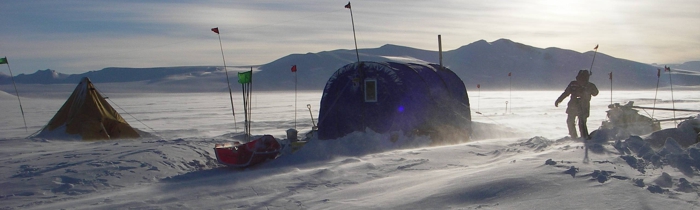
ANZICE (Antarctica-New Zealand Interglacial Climate Extremes) was a scientific research programme funded by the New Zealand Foundation for Research Science and Technology. It was closely aligned with the FRST-funded Global Change Through Time programme at GNS Science and linked with the ice core, gas analysis group at NIWA. The aim was to understand the likely response of the New Zealand-Antarctic region to a warmer world. To achieve this, the project focused on environmental changes that occurred during peak warm periods in the past when the atmosphere and surface ocean were up to 3 degrees C warmer than now.
Such temperature increases are in line with those indicated for the next century by the Intergovernmental Panel on Climate Change (IPCC). We believe that by deciphering detailed environmental records of the previous warm periods, we can provide a template for the future.
KEY RESULTS
1. Dust and chemical records from ice cores
Results: The chemistry and dust content in ice cores from coastal Antarctica were used to identify two distinct air mass source regions, the paths taken by different air masses, and the paths of cyclones that deliver snow in the Ross Sea.
Potential implications: The identification of cyclone activity and the associated weather patterns in ice cores enables us to extend climate records back in time with high precision. This expanded record is the foundation for more accurate climate projections.
Publications:
Markle, B.R., Bertler, N.A.N., Sinclair, K.E., Sneed, S.B. (2012). Drivers of air mass trajectories in the Ross Sea Region, Antarctica as seen from back-trajectory modelling and ice core analysis. Journal of Geophysical Research 117, D02113. doi:10.1029/2011JD016437, 2012
Sinclair, K.E., Bertler, N.A.N., and Trompetter, W.J., 2010. Synoptic controls on precipitation pathways and snow delivery to high-accumulation ice core sites in the Ross Sea region, Antarctica. Journal of Geophysical Research 115, D22112, doi:10.1029/2010JD014383
2. Climate conditions in Antarctica during the Little Ice Age
Results: It has been argued that the Little Ice Age was the most recent of the “Dansgaard Oeschger” abrupt changes in climate that occurred during the ice age. According to the classical “see-saw” hypothesis, Antarctica should have been warm during the Little Ice Age. Our ice core data show that climate conditions in Antarctica during the Little Ice Age were colder, stormier and drier, sea surface temperatures were colder and sea ice more extensive compared to now.
Potential implications: Evidence for the Little Ice Age comes mainly from the N. Hemisphere. Its presence in Antarctic reveals the strong climatic links between hemispheres. While also evident in New Zealand, it is less distinct suggesting buffering of the ice age by climate and/or ocean forces from the subtropics.
Publications:
Bertler, N.A.N., Mayewski, P.A., Carter, L., (2011). Cold conditions in Antarctica during the Little Ice Age - Implications for abrupt climate change mechanisms. Earth Planetary Science Letters 308(1): 41-51. doi:10.1016/j.epsl.2011.05.021
3. Lake Tutira – climate change over the last 7000 years
Results: Analysis of sediment cores from Lake Tutira, Hawkes Bay, shows that New Zealand’s climate is strongly influenced by climate cycles from the Equator (El Niño-La Niña) and from Antarctica (Southern Annular Mode). The 7000 year-old lake record suggests that when these two climate forces work together there is increased in storms.
Potential Implications: Under the present warming, the positive phase of the Southern Annular Mode has prevailed over Antarctica and the Southern Ocean for about the last ~50 years. In this phase, strong westerly winds move south, and this appears to favour the effects of La Niña weather patterns. This was the case in 2010-2011 when parts of New Zealand suffered severe rainfalls under enhanced La Niña weather.
Publications:
Gomez, B., Carter, L., Orpin, A., Cobb, K., Page, M., Trustrum, N., Palmer, A., (2011). ENSO / SAM interactions during the middle and late Holocene. The Holocene 22(1): 23-30. doi:10.1177/0959683611405241
Orpin, A.R., Carter, L., Page, M.J., Cochran, U.A., Trustrum, N.A., Gomez, B., Palmer, A.S., Mildenhall., D.C., Brackley, H.L., Northcote, L., (2010). Holocene sedimentary record from Lake Tutira as a template for upland watershed erosion proximal to the Waipaoa sedimentary system, North-eastern New Zealand. Marine Geology 270(1): 11-29. doi: 10.1016/j.margeo.2009.10.022
Page, M.J., Trustrum, N.A., Orpin, A.R., Carter, L., Gomez, B., Cochran, U.A., Mildenhall, D.C. , Rogers, K.M., Brackley, H.L., Palmer, A.S., Northcote, L., (2010). Storm frequency and magnitude in response to Holocene climate variability, Lake Tutira, north-eastern New Zealand. Marine Geology 270(1): 30-34. doi:10.1016/j.margeo.2009.10.019
4. Southern Ocean Oceanography – past and present
Results: During past warm-cold climate cycles, the basic water mass structure off New Zealand remained unchanged although temperatures varied in time and space. During peak warm periods, the ocean warmed with the largest increases (relative to modern temperatures) observed off southern New Zealand, which has direct climate and ocean links with Antarctica and the Southern Ocean.
Potential Implications: Increases in temperature of the upper ocean are likely to be highest off southern New Zealand, possibly reflecting the direct ocean/climate links with the southern polar region where rising temperatures are locally amplified, e.g. Antarctic Peninsula. Such warming can bring about a marked change in plankton that form the base of the marine food chain – this is being currently studied in the ANZICE programme.
Publications:
Carter, L., McCave, I.N., and Williams, M., (2008). Circulation and water masses of the Southern Ocean: A review. In Florindo, F., Siegert, M. (editors), Antarctic Climate Evolution, Developments in Earth and Environmental Sciences 8. Elsevier, Amsterdam, 606pp.
Hayward, B.W. Scott, G.H., Crundwell, M.P., Kennett, J.P., Carter, L., Neil, H.L., Sabaa, A.T., Wilson, K., Rodger, J.S., Schaefer, G., Grenfell, H.R., Qianyu Li., (2008). The effect of submerged plateaux on Pleistocene gyral circulation and sea-surface temperatures in the Southwest Pacific. Global and Planetary Change 63(4): 309-316. doi 10.1016/j.gloplacha.2008.07.003
McCave, I.N., Carter, L., and Hall, I.R., (2008). Glacial-interglacial changes in water mass structure and flow in the SW Pacific Ocean. Quaternary Science Reviews 27: 1886-1908. doi.org/10.1016/j.quascirev.2008.07.010
5. Active margin response to storms – Eastern North Island
Results: Assessment of the Waipaoa River and adjacent seabed off Gisborne shows that storms deliver large amounts of sediment to the continental shelf, reflecting storm intensity as well as long-term effects of earthquakes and deforestation. Such influxes of mud temporarily overwhelm the shelf. However, waves and currents cause most of the mud to pass into deeper water allowing the shelf to return to “normal”.
Potential Implications: A warmer world is projected to have more intense storms including rainfall. The research indicates the landscape undergoes marked erosion (e.g. Cyclone Bola), but the continental shelf, while temporarily inundated with mud from river floods, can recover under normal wave and current activity.
Publications:
Brackley, H.L., Blair, N., Trustrum, N.A., Carter, L., Leithold, E.L., Canuel, E.A., Johnston, J., Tate, K.R., (2010). Dispersal and transformation of organic carbon across an episodic, high discharge continental margin; Waipaoa Sedimentary System, New Zealand. Marine Geology 270: 201-212. doi: 10.1016/j.margeo.2009.11.001
Carter, L., Orpin, A., and Kuehl, S., (2010). From mountain source to ocean sink – the passage of sediment across an active margin, Waipaoa sedimentary system, New Zealand. Marine Geology 270: 1-10. doi.org/10.1016/j.margeo.2009.12.010
Kniskern, T.A., Kuehl , S.A., Harris , C.K., Carter, L., (2010). Sediment accumulation patterns and fine-scale strata formation on the Waiapu River shelf, New Zealand. Marine Geology 270: 188-201. doi.org/10.1016/j.margeo.2008.12.003
6. Environmental Proxies
Results: Techniques and calibrations were developed specifically for the SW Pacific Ocean for the use of the calcium/ magnesium ratio in the shells of foraminiferal plankton, to determine the temperature of the surface ocean at the time when the plankton formed. Two plankton species, dwelling at different depths, were found to be good thermometers of the ocean at ~50m and ~150m water depth.
Potential Implications: A new means of deriving temperatures in the SW Pacific is allowing improved reconstructions of the past ocean. The technique also provides other chemical data that helps identify different water masses.
Publications:
Bolton, A., Baker , J., Dunbar, G., Carter, L., Neil, H., Smith, E., (2011). Environmental versus biological controls on Mg/Ca variability in Globigerinoides ruber (white) from core top and plankton tow samples in the southwest Pacific Ocean. Paleoceanography 26, PA2219, 14pp. doi:10.1029/2010PA001924
Marr, J.P., Baker, J.A., Carter, L., Allan, A.S.R., Dunbar, G.B., Bostock, H.C., (2011). Ecological and temperature controls on Mg/Ca ratios of Globigerina bulloides from the southwest Pacific Ocean. Paleoceanography 26, PA2209. doi:10.1029/2010PA002059
7. South Island Glaciers – responding to change
Results: Extensive field measurements of snow accumulation and melting have been carried out on Brewster, Franz Josef, and Tasman glaciers in the Southern Alps. These measurements helped develop a new model of New Zealand glaciers. The model shows that our glaciers are amongst the most sensitive in the world and will retreat strongly if climate warming continues.
Potential Implications: The sensitivity of New Zealand glaciers to temperature is significant because glacier melt is an important source of water for hydroelectric power generation and irrigation in the eastern South Island. The model shows that water run-off from glaciers will initially increase and then decrease in the long term if climate warming continues.
Publications:
Anderson, B., Mackintosh, A., Stumm, D., George, L., Kerr, T., Winter-Billington A., Fitzsimons, S., (2010). Climate sensitivity of a high-precipitation glacier in New Zealand. Journal of Glaciology 56(195): 114-128.
Purdie, H., Anderson, B., Lawson, W. Mackintosh, A., (2011). Controls on spatial variability in snow accumulation on glaciers in the Southern Alps, New Zealand; as revealed by crevasse stratigraphy. Hydrological Processes 25, 54-63.
Purdie, H., Mackintosh, A., Lawson, W., Anderson, B., Chinn, T., Mayewski, P., (2011). Interannual variability in net accumulation on Tasman Glacier and its relationship with climate. Global and Planetary Change 77(3-4): 142-152. doi:10.1016/j.gloplacha.2011.04.004
8. Stability of Antarctic Ice Shelves – model simulations
Results: Increased melting during the summer over ice shelves at both poles is closely related to ice shelf collapse. In order to explore possible future ice shelf loss, particularly over the large Ross and Ronne-Filchner ice shelves of Antarctica, a global climate model was used to assess future changes in Positive Degree Days (a measure of melting intensity). Under “business-as-usual” emission of carbon dioxide, the model projected a large increase in Positive Degree Days over those ice shelves. However, if greenhouse gas levels remained the same as today, these ice shelves remained in the low-melt regime.
Potential Implications: This work suggests that if emissions are not markedly reduced in coming decades, strong melting will occur over the Ross and Ronne-Filchner ice shelves that would likely contribute to their decay and possible loss. This has implications for the stability of the grounded West Antarctic Ice Sheet. However, if strong measures are taken to reduce carbon emissions in the near future, this strong melting can be avoided. In the Arctic, it appears that even if strong reductions in emissions occur, all remaining Arctic ice shelves will likely be lost in the near future.
Publications:
Fyke, J.G., Carter, L., Mackintosh, A., Weaver, A.J., Meissner, K.J., (2010). Surface melting over ice shelves and ice sheets as assessed from modelled surface air temperatures. Journal of Climate 23(7): 1929-1936. doi: 10.1175/2009JCLI3122.1
9. Changes in Antarctica due to increased melting by the ocean
Results: Extensive work was carried out to develop a new coupled ice sheet/climate model that is capable of simulating the dynamic response of the Greenland and Antarctic ice sheets to climate change. The model consists of high resolution ice sheet models that are 'nested' within a global climate model. The resulting 'coupled' model captures the main interactions between ice sheets and climates, and successfully reproduces the modern surface conditions and geometry of the Antarctic and Greenland ice sheets. Model performance was also evaluated under climate conditions of the last ice age and the preceding warm period.
Potential Implications: The creation of a new coupled ice sheet/climate model is an important contribution to understand past ice sheet behavior, and the potential response of the Antarctic and Greenland ice sheets to future climate change. Additionally, the model can be used as a test-bed for technologies and techniques that could be used in more complex global models for quantitative projections of sea level change produced by melting ice sheets.
Publications:
Fyke, J.G., Weaver, A.J., Pollard, D., Eby, M., Carter, L., Mackintosh, A., 2010. A new coupled ice sheet-climate model: description and sensitivity to model physics under Eemian, Last Glacial Maximum, late Holocene and modern climate conditions. Geoscientific Model Development Discussions 3: 1223-1269, doi:10.5194/gmdd-3-1223-2010.
Policy
One of the main purposes of climate science is to provide reliable knowledge that can be used by society to make decisions concerning our relationship and responses to a climate system that is undergoing marked change. This involves:
- increasing our knowledge of the climate system and human interactions with this system (scientific basis),
- helping to understand the nature, scale and timing of climate change risk (vulnerability),
- helping to develop realistic climate change adaptation goals and strategies (adaptation), and
- helping the formulation of realistic climate change mitigation goals and strategies (mitigation).
Results are summarised in the ANZICE Policy Overview
Publications and Podcasts
The following publications produced by the ANZICE project are available to download.
A series of podcasts together with illustrated commentaries about various aspects of ANZICE science is available below and from the website Sci Blogs.